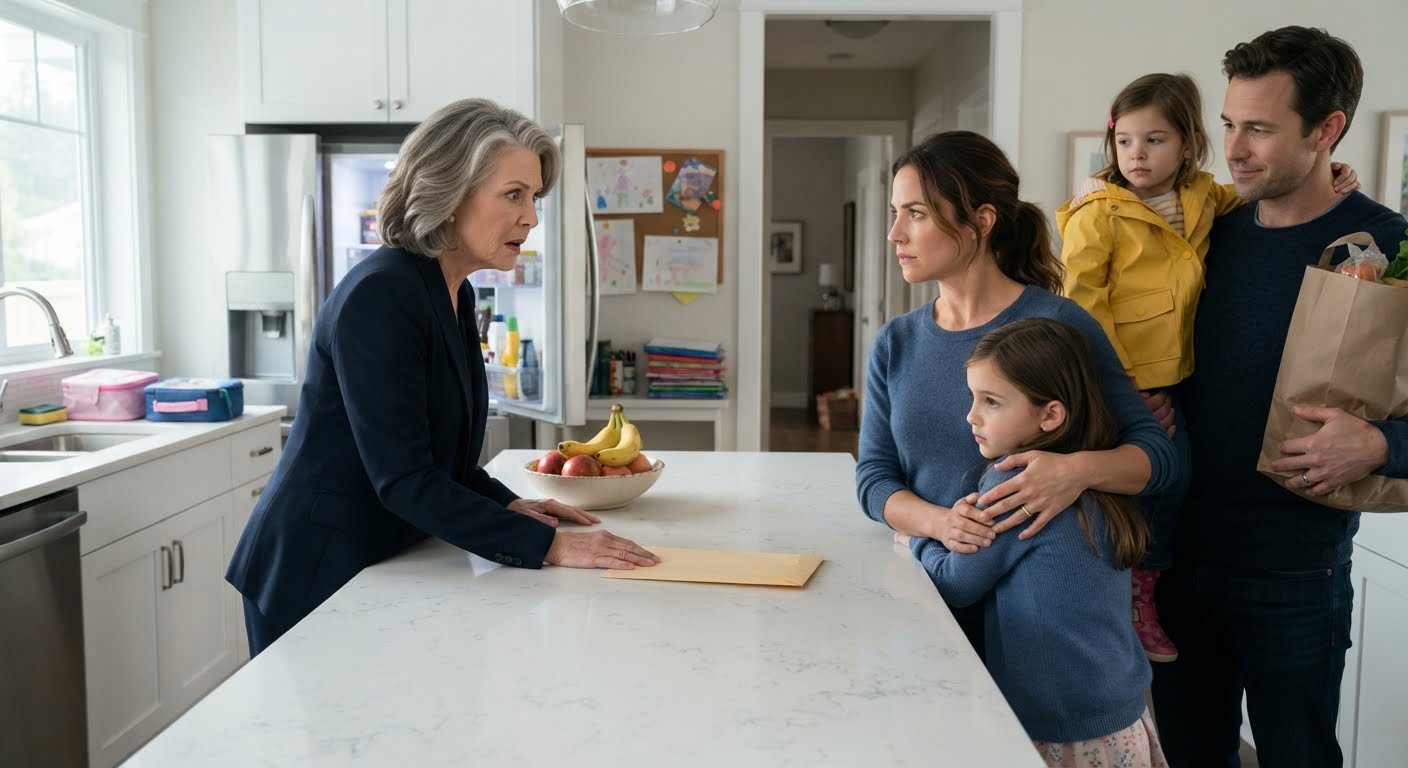
The First thing my mother did when she walked into my new house was admire the kitchen. The second thing she did was give away three bedrooms.
“This kitchen is gorgeous,” she said, running her fingertips along the white quartz island. Then she glanced toward the hallway and added, “With three spare bedrooms, your brother’s family will finally have room to breathe. Ryan already gave his landlord notice.”
She had been inside less than four minutes. Apparently, the tour included a complimentary transfer of ownership.
I stood across the island watching Diane Whitmore make arrangements for rooms she had never entered. Beside the fruit bowl sat a cream envelope—the reason I had invited her—but she hadn’t noticed it yet.
For most of my life, my mother had treated my objections as symptoms of an unfortunate personality. I was sensitive when I wanted something returned, dramatic when I questioned a decision, and selfish when my paycheck developed plans of its own.
My name is Mara Whitmore. At twenty, I lent my brother my first car, and he drove it into a mailbox; I paid the deductible while Mom explained how terrible he felt. When he lost his job at a plumbing supply company, I covered groceries for four months. Mom reminded me that he had children, as though I had misplaced that information somewhere between the milk and the electric bill.
Later, Ryan and his wife, Kelsey, enrolled their twin daughters in a private elementary school they couldn’t comfortably afford. Mom called me before they called the school.
“You’ve always been responsible,” she said. “And you don’t have children. You can help.”
When I declined, she stopped speaking to me for six weeks. I spent those weeks wondering whether I had been cruel, which was how her silences usually worked.
Then Dad died, and the familiar requests became something I couldn’t explain away.
Thomas Whitmore had built modest but solid wealth: investments, savings, retirement accounts, and part ownership of a commercial property. He liked to say he wanted both his children to have “a soft place to land.”
At his funeral, neighbors were still carrying casseroles into the church basement when Mom hugged me. I leaned against her, grateful for the comfort, until she whispered, “Don’t make this about money. Your brother needs stability.”
I hadn’t asked about money. I was trying to get through the afternoon without crying into somebody’s potato salad.
Three weeks later, she explained that Dad had changed his plans. Ryan’s landscaping company needed help, and protecting the grandchildren meant directing much of the available money into the business.
“What about my share?” I asked.
“You have a career,” she said. When I asked what that had to do with it, she answered, “Ryan has a family.”
Documents appeared in front of me, thick with account summaries and language I struggled to follow while grieving. I signed one acknowledgment and refused another; Mom cried, and Ryan called me greedy. Money I had understood would be divided between us went into his company. Eleven months later, the company failed, with Ryan blaming equipment costs and Mom blaming his business partner.
I ended up in a studio above a laundromat. At eleven every night, the dryers vibrated beneath my floor—an appliance orchestra with absolutely no interest in requests.
One evening, unable to sleep, I opened Facebook and saw Ryan’s family in Florida. Matching shirts, a resort pool, and Mom’s comment underneath: “So happy my babies can finally relax.”
I stared at it for a long time. Then I blocked them.
For four years, my mother knew almost nothing about my life. She could keep imagining the daughter upstairs from the dryers, because I no longer called to correct her. I worked, earned a promotion, saved, and invested. Eventually, I bought a little blue house and rented it out, checking the numbers myself instead of trusting somebody who told me numbers were unkind.
I also met Ethan Brooks in an urgent care waiting room, eighteen months after Dad died. I had a sprained wrist; his daughter Lily had introduced a bead to her nose—an ambitious craft project nobody had approved.
He made me laugh when I didn’t think I had much laughter left. Our relationship grew, and later he introduced me properly to Lily and her younger sister, Grace.
Their mother had died when Grace was a toddler. I never tried to take her place; I learned how to show up in my own.
There were school plays, dentist appointments, science projects, and pancakes that should have been removed from the stove several minutes sooner. There were ordinary evenings when somebody needed a clean shirt or someone to sit beside her until a nightmare loosened its grip.
The first time Grace accidentally called me “Mom,” she cried because she thought she had done something wrong. I knelt beside her and held her while she wrapped both arms around my neck.
“You didn’t do anything wrong,” I told her. I meant every word.
Ethan and I married near Lake Michigan, with Lily carrying yellow flowers and Grace dropping the rings twice. I didn’t invite my mother; I wanted one important day she couldn’t rearrange around Ryan.
Later, we bought this house together. Four bedrooms, a garden, a breakfast nook Lily claimed for homework, and a kitchen spacious enough for Ethan to dirty every pot while attempting French food. We argued over the pendant lights for three weeks. Grace labeled the pantry with crooked stickers, and somehow those stickers made it feel more like home than anything the real estate agent had pointed out.
Three months after we moved in, an unfamiliar number called. I almost ignored it, but the woman introduced herself as Nora Caldwell, who had worked for Dad’s estate attorney.
“I think we need to meet,” she said.
That conversation led to the envelope beside the fruit bowl. Mom believed my invitation meant reconciliation; I had invited her because I needed to see what she would say when I showed her what had been found.
Instead, she was assigning bedrooms.
“Ryan and Kelsey should take the room facing the garden,” she continued. “The twins can share the one near the upstairs bathroom. Kelsey wants them close.”
“You discussed my bedrooms with Kelsey?”
“I sent her the listing.” Mom gave a little wave, as though that cleared everything up. “Mara, don’t turn this into a thing.”
“You told them they could move in without asking me?”
“Family doesn’t ask permission.”
She opened the refrigerator and frowned at its contents. We would need a second one in the garage, she decided, because Ryan’s girls drank so much milk.
I looked from her hand on my refrigerator door to the cream envelope. She hadn’t asked how I had been, who used the breakfast nook, or why two lunch boxes stood beside the sink.
“You have more space than you need. Their rent went up. This solves everyone’s problem.” She shut the refrigerator. “You won’t be rattling around by yourself, and maybe you’ll finally feel part of the family again.”
Before I answered, the front door opened. Lily came into the kitchen in her yellow raincoat, calling, “Mommy!”
She stopped when she saw my mother. “Grandma’s here?”
Eight-year-old Grace followed, holding the edge of Ethan’s jacket. He carried two grocery bags, and when our eyes met, I knew he remembered our conversation the night before: let me speak for myself.
Mom looked at the girls, then at Ethan’s wedding ring, then finally at mine. For someone who had inspected the refrigerator so carefully, she had missed a surprising number of details.
“Yes.” I rested a hand on Grace’s shoulder. “These are my stepdaughters. Daughters in every way that matters.”
“You didn’t tell me?” Mom asked, then immediately added, “What does Ryan know about this?”
She recovered enough to say Ethan should understand why Ryan needed help. A few months, perhaps a year; surely we could make room.
“No one is moving in,” I said. “Ryan needs to call his landlord.”
Mom looked toward Ethan for support. He stayed beside the girls while I slid the envelope across the island.
She opened it and read Dad’s trust document. Beneath his signature was an attached instruction: I was not to be Ryan’s financial backstop, and advances to him or his businesses were to come solely from his share.
Her fingers tightened on the page. Then she noticed Nora Caldwell’s name, and for the first time since entering my kitchen, she stopped making plans.
“This was never executed,” Mom said. Her eyes stayed on the signature section, where Dad’s name appeared alongside the attorney’s and Nora’s. “It was a draft.”
“The original was recovered from an archived client box when the law office moved,” I told her. “This copy is certified. My attorney has the original.”
She said it too quickly to pretend the name meant nothing. Ethan guided the girls toward the breakfast nook while I drew the second document out from beneath the first.
A forensic examiner had compared Dad’s verified signatures with the one on the authorization redirecting money allocated to me directly into Ryan’s company. The conclusion was undeniable: the disputed signature wasn’t Dad’s, and the ink analysis indicated it had likely been added after his death.
The witness line carried my mother’s name.
“You signed as witness,” I said.
“I signed hundreds of things for your father.” She straightened the pages against the counter—an old habit whenever something untidy needed to become somebody else’s problem.
“You witnessed him signing this?”
“You have no idea what was happening then.”
I told her the civil complaint had been filed on Friday. Before she could answer, the doorbell rang, followed by three hard knocks.
Mom caught my wrist. “Before Ryan says anything, you need to understand that he doesn’t know everything.”
Then his voice boomed through the door. “Mara! Open up! I brought the bank statements!”
Her hand fell away. I went to the foyer and found Ryan in jeans and work boots, holding a thick folder, with Kelsey beside him and neither twin in sight.
“You could’ve answered my calls,” he said.
“You could’ve asked before planning to move into my house.”
He frowned. “Mom said you offered.”
I stepped aside and looked toward her. Kelsey explained that Mom had shown them text messages, then unlocked her phone and held out screenshots supposedly sent by me.
In them, I had claimed I had too much space, wanted to put old arguments behind us, and warmly invited their family to stay for a year. The phrasing was familiar enough to be unsettling, but I had never written any of it.
“I didn’t send these,” I said.
Ryan turned toward Mom. She answered defensively that she was only trying to bring the family back together because we weren’t speaking.
“By pretending to be me?” I asked.
Ethan spoke quietly from beside the girls. “You made a decision for her and misrepresented it.” When Mom snapped that this was family business, Ethan rested an arm around Grace. “So am I.”
Ryan dropped the folder onto the quartz island. “Then explain this.”
The bank statements covered almost four years. After the landscaping company failed, Mom had told him the estate had overpaid him and that I had demanded repayment of my portion.
“I’ve been paying it back,” he said, his voice dropping. “Two hundred here, five hundred there. Tax refunds. My warehouse bonus. Whatever we could spare.”
Kelsey looked down at the pages, shocked. “We skipped vacations for two years.”
Mom ordered Ryan to stop talking, but he pointed a trembling finger at the recipient line: M. Whitmore Restoration Account. For a fleeting moment, I wondered whether she had quietly been trying to repair what she had broken.
Then I recognized the routing number. Nora and my attorney had shown it to me two weeks earlier; the account belonged solely to Diane.
“About seventy-eight thousand.” Ryan swallowed hard. “I thought I was paying you back.”
I looked at those ordinary amounts—saved from ordinary paychecks by a brother trying to do right by a debt that never existed—and felt my anger change shape. For years, I had believed he never returned a cent, while he believed I had been bleeding him dry.
The repayments began six weeks after Ryan’s business closed. Every month or two, he sent Mom money while she fed each of us different stories about the other.
“Your father left me with a mess,” she said.
“Dad left paperwork.”
She pressed a hand against the island. For forty years, she claimed, Dad had controlled every dollar. Purchases required discussion, and credit card statements became interrogations.
I listened, knowing I didn’t understand every detail of their marriage. But marital unhappiness couldn’t justify a forged signature or letting me believe Dad had deliberately denied my inheritance.
Kelsey asked who had written the disputed document. Mom looked at her, then sank onto a stool.
“I was trying to protect the family.”
“From what?” I asked.
“From the truth.” She shut her eyes. “Your father was going to cut Ryan off.”
Ryan stared. Mom explained that the trust document wasn’t everything. Dad had also written a letter after discovering how much money she had secretly given Ryan over the years—car payments, rent, groceries, tuition, emergencies. She listed them as Ryan stood with both hands pressed against the counter.
“You told me Dad approved that,” he said.
“He didn’t.”
Dad had uncovered the transfers and insisted Ryan would never become independent while she kept rescuing him. He had revised the trust and specified that I should never be pressured into supporting my brother.
For years, I’d thought Dad had placed me second even after death. Now Mom revealed he’d recognized the pattern I’d struggled to escape and had tried stopping it.
“Where’s the letter?”
She lowered her gaze. “I burned it.”
Nora had mentioned missing correspondence. Gripping the island, I asked about the transfer authorization. Mom claimed she’d needed time to make things right. If Ryan’s business succeeded, she argued, everything could have been restored. Ryan’s face changed when he realized Dad hadn’t invested because he finally trusted him, despite Mom’s claims.
“I didn’t know,” he said to me.
I wanted to remain angry in a familiar way. Ryan had expected assistance before, accepted it, and called me greedy for objecting. His pain didn’t erase those choices.
Yet the statements showed he’d also been manipulated. Mom had kept us supplied with reasons to resent each other, maintaining her role as interpreter while we fought.
Ethan leaned toward the folder. “What are those withdrawals?”
Among Ryan’s deposits were regular transfers to D.W. Property Holdings LLC. My attorney had already discovered the company while tracing estate funds, though we hadn’t identified its assets.
Kelsey searched county property records on her phone. A Sarasota condominium had been purchased in cash through that company eighteen months after Dad died.
Mom rose and reached for her purse. Ryan blocked her path, demanding to know where the money came from, while she ordered him aside.
“Look at the deed,” Kelsey said.
Six months after its purchase, the property’s ownership had transferred to Charles Mercer. I recognized the name when I took the phone.
“Charlie Mercer?” I asked.
Mom closed her eyes. Charlie had been Dad’s business partner until a bitter dispute during my college years. Dad said Charlie had cheated him in a development deal. I believed they hadn’t communicated in years.
Nora had mentioned an old associate contacting the attorney after Dad’s death, asking whether a newer trust existed. I couldn’t confirm from memory who called, but now we had someone to investigate.
I opened the commercial property records my attorney had emailed the previous night. They documented Dad’s dispute with Charlie, including accusations of diverted partnership revenue. No lawsuit followed; Dad bought Charlie out. Seeing the deed alongside those records, I realized the missing funds went far beyond Ryan’s failed business.
I asked about the equipment auction following Ryan’s business failure. Trucks, trailers, lawnmowers, and a skid steer had been partly purchased with estate funds before being sold.
Ryan said different buyers purchased them. When I asked who organized the auction, he answered, “Mom’s friend,” glancing toward her.
“Charlie arranged buyers,” Mom admitted.
Ryan stepped away from the counter, demanding to know whether his business had been used to conceal what happened to Dad’s money.
Mom claimed she’d been trying to recover money Dad owed Charlie. The documents I’d just reviewed told another story, and I asked why she had believed Charlie.
“I loved him,” she said.
Nobody immediately responded. Wiping her cheek, she explained their relationship had started years earlier, ended, and then resumed when Dad became ill.
Ryan sat down. “With Dad’s former business partner?”
“Yes.”
Charlie had claimed Thomas cheated him and showed Mom records she believed. He promised they’d share the condominium, but transferred ownership to himself and, according to her, stopped answering calls three months later.
She had betrayed Dad, diverted his funds, and ultimately been deceived by the man she trusted. I could recognize her devastation without excusing the harm she’d caused us.
“Why my house?” I asked.
She glanced down the hallway as though hoping for an easier conversation. Ryan pressed her to answer, and she finally admitted receiving a demand letter from Charlie. He demanded $200,000 or threatened to report everything to authorities. Kelsey called it blackmail, and Mom agreed.
“You thought I would pay?”
“Once the family was together again, perhaps you would help.” She looked at me. “I was going to ask you to refinance.”
The bedrooms, sudden reconciliation, and Ryan’s supposed landlord notice were all pieces of another crisis I was expected to resolve. She hadn’t even known who lived in my home before deciding it could finance her escape.
“You planned to move Ryan’s family in and then ask me to mortgage this house?”
“When you say it like that—”
“How else can I say it?”
My phone rang before she answered. My attorney was calling, so I stepped into the dining room, still keeping Mom in sight.
He asked whether Diane was present and instructed me to preserve the evidence. They had located Charles Mercer in Sarasota and uncovered more information. Mercer had contacted federal authorities two months earlier and was cooperating with investigators. According to his lawyer, he hadn’t sent the demand letter.
“Then who sent it?” I asked.
The PDF metadata showed it was created on a laptop registered to Ryan Whitmore.
I looked into the kitchen. Ryan noticed my expression and stood. “Mara.”
I returned and explained my attorney’s findings. Mom stared at Ryan as Kelsey moved away from him.
“You?” Mom asked. “You blackmailed me?”
He rubbed his face. Six months earlier, he had identified an equipment-auction buyer linked to Charlie and started investigating.
“I sent the letter,” he admitted. “I wanted to know if she’d pay.”
Kelsey said he had claimed it came from a collection attorney. Ryan explained he wanted proof Mom still had money after taking their $78,000 while repeatedly insisting nothing remained.
“You set me up,” Mom whispered.
“You’ve been setting us up our whole lives.”
Ryan turned toward me, claiming he’d never intended to collect the money. I wanted to trust him, but his admission proved something painful: being deceived hadn’t prevented him from deceiving others.
I stood in the kitchen Ethan and I had created for ordinary family life. We’d never bought this house to negotiate which lies deserved forgiveness.
Final Chapter
I glanced toward Ethan and the girls. Lily’s bright raincoat still hung near the breakfast nook, while Grace stayed close to him as the adults attempted to justify the choices that had hurt one another.
I had created a life beyond those patterns. I couldn’t welcome them inside and call it reconciliation.
“No one is moving in,” I said.
Ryan nodded. “I know.”
“No one is borrowing money. And no one is handling this privately.”
Mom started protesting, but I reminded her my attorney already had the civil complaint. He would also receive Ryan’s statements and everything we’d discovered that afternoon.
“I’m your mother,” she said. “You would do this to me?”
Once, that question would have sent me searching for a smaller, more agreeable version of myself. But holding Dad’s instructions, I felt sadness instead.
“I’m not protecting you from what you did anymore.”
Ryan rested against the counter. “What happens to us?”
“I don’t know.”
I wouldn’t invent reassuring answers. Attorneys, investigators, and consequences awaited us, none of which could be resolved by prioritizing someone’s feelings.
Investigators eventually established that Mom had diverted hundreds of thousands of dollars from Dad’s estate and trust assets. Some funded Ryan’s business, some went to Charlie, and some purchased the Sarasota condo. Charlie’s earlier fraud formed part of the history, and the romantic future he’d promised Mom had largely been another deception. But that didn’t make her innocent of mishandling Dad’s money.
Ryan surrendered all his bank records. His fabricated demand letter created legal complications, but because he’d received no money and cooperated fully, his attorney negotiated the consequences. Cooperation didn’t erase his actions. His marriage also suffered; Kelsey separated from him for three months before they cautiously entered counseling.
The following year, Mom pleaded guilty to financial crimes. I skipped sentencing, unwilling to turn it into another family occasion where I’d be expected to comfort everyone. I sent her a single letter containing one sentence: Dad was right—I was never supposed to be Ryan’s safety net, and I was never supposed to be yours either.
My brother and I didn’t suddenly become close friends. Bank records couldn’t heal every old wound, including things he had said and beliefs I had carried for years.
But one Saturday the following spring, he appeared with a toolbox. Standing awkwardly on the porch, he explained that Kelsey had mentioned our sagging gate.
“It is,” I said.
“I can fix it.”
I almost declined. Then Grace appeared behind me and asked, “Is that Uncle Ryan?”
He looked surprised. I’d never introduced him that way, but Lily had apparently shown Grace an old family photo.
“I guess I am,” he said, crouching to her level.
Grace studied him before asking if he could repair swings. Ours squeaked, she explained with the seriousness of someone hiring a professional.
“Sounds serious,” he said.
She took his hand and guided him toward the backyard. Ethan joined me and asked whether I was okay. I nodded, watching Ryan pause beside the garden. He glanced back at the upstairs windows, toward the rooms Mom had once promised away without permission.
“For what it’s worth, I called the landlord,” he said.
“What did he say?”
“He never processed our notice. Mom only told me she mailed it.”
Of course she had. Ryan shook his head, chuckled quietly, and followed Grace to the swings.
I remained in the doorway. Lily worked on homework at the breakfast nook, Ethan unpacked groceries, and Grace directed repairs outside.
Ryan wasn’t moving in. He had offered to repair something, and I had allowed him the opportunity. That was enough for one Saturday.
For the first time, family no longer sounded like an obligation I owed. It meant the people who lived here, the choices we made together, and a door I was finally free to open myself.